The best online GLP-1 provider is the one that reviews your health history before prescribing, tells you exactly what weight loss medication you’re getting and where it comes from, shows the full price up front, and keeps caring for you after the first shipment. Price matters, but it’s the last thing to compare, not the first. Whether you’re paying out of pocket or hoping for insurance coverage, the same checks apply. The point of GLP-1 treatment is to help you lose weight safely and keep it off, and the provider is a bigger part of that than the brand on the vial. This guide is for adults considering GLP-1 weight loss treatment through telehealth. It explains how to choose a GLP-1 provider online: how prescriptions work, who qualifies, the seven things to check before you sign up, how insurance and cash-pay models differ, what the FDA says about compounded GLP-1s, and the red flags that mean you should look elsewhere.
What an online GLP-1 provider does
GLP-1 medications are prescription drugs for weight loss and type 2 diabetes, so you can’t buy them without a prescription. An online GLP-1 provider is a telehealth platform that connects you with a licensed healthcare provider who reviews your health information, decides whether weight loss treatment is appropriate, and, if it is, sends a prescription to a pharmacy that ships it to you. You typically complete an online assessment or intake form first, a medical provider reviews it, and follow-up care happens through messaging rather than office visits.
Semaglutide and tirzepatide are the two most commonly prescribed GLP-1 medications for weight management. Semaglutide is the active ingredient in Ozempic® and Wegovy®, and tirzepatide is the active ingredient in Mounjaro® and Zepbound®. Provn does not sell these branded products. They’re named here for context only.
GLP-1 medications work by mimicking a gut hormone that helps regulate appetite and helps control blood sugar. They slow how quickly your stomach empties, signal fullness to your brain, and help your pancreas release insulin when a meal raises blood sugar. That’s why the same class of GLP-1 medications is used both for type 2 diabetes and to support weight loss. Many patients describe the effect as a drop in “food noise,” the constant background thinking about what to eat next. Less food noise is one reason GLP-1s support weight loss better than willpower alone for many people. For a fuller explanation, see our guide to how GLP-1 medications work for weight loss.
Why the provider matters more with GLP-1s than with most medications
GLP-1 therapy isn’t a one-time prescription. The dose starts low and increases over several weeks, side effects need managing along the way, and clinical trials show that most people regain weight after stopping. In the STEP 1 trial extension, participants regained about two-thirds of their lost weight within a year of stopping semaglutide. That makes it a long-term weight loss treatment that needs medical supervision and a personalized treatment plan, not a single order. The medical provider you pick is the one who will adjust your dose, answer questions about side effects, help you lose weight safely, and decide with you how long to continue. Choosing well at the start saves you from switching providers in the middle of your weight loss journey, and a weight loss journey with GLP-1s is measured in months, not weeks.
Who qualifies for GLP-1 treatment
The FDA-approved prescribing information for Wegovy and Zepbound describes use in adults with obesity, or with overweight plus at least one weight-related condition. In the trials behind those labels, obesity meant a body mass index (BMI) of 30 or higher and overweight meant a BMI of 27 or higher, with conditions such as high blood pressure, type 2 diabetes, high cholesterol, or obstructive sleep apnea. If you have sleep apnea or high blood pressure, say so on the intake form, since it can affect whether you qualify. Both labels say the medication is to be used alongside a reduced-calorie diet and increased physical activity, not instead of them.
Other conditions linked to excess body weight are often part of the conversation with your healthcare provider. Wegovy injection, for example, now carries a separate indication for a form of fatty liver disease (noncirrhotic MASH with moderate to advanced scarring), approved under the FDA’s accelerated pathway.
Both labels also carry a boxed warning (sometimes called a black box warning) about thyroid C-cell tumors seen in rodent studies. Neither is for people with a personal or family history of medullary thyroid cancer or Multiple Endocrine Neoplasia syndrome type 2 (MEN 2). Expect any serious provider to ask about family history of thyroid cancer specifically. Both labels say to stop the medication if pancreatitis is suspected, and both are to be stopped if pregnancy is recognized. A good medical provider screens for all of this before prescribing, because GLP-1s lower blood sugar and can interact with diabetes medication, and because the conditions above change the risk. The NIDDK has a plain-language overview of who prescription weight management medications are for.
How much weight loss to expect, according to clinical trials
Weight loss with GLP-1 medications is gradual. The Wegovy label reports that adults in its main 68-week trial lost an average of 14.9% of their body weight, compared with 2.4% on placebo. The Zepbound label reports average weight loss of 15.0% to 20.9% over 72 weeks at the 5 mg to 15 mg doses, compared with 3.1% on placebo. Those are averages from approved products in controlled trials. Individual results vary widely, and no provider can promise you a specific number. Compounded medications are not FDA-approved and were not studied in those trials.
What a good GLP-1 treatment plan includes
Whether you choose an online provider or an in-person clinic, a GLP-1 weight loss treatment plan should have the same parts:
A medical evaluation first. A licensed healthcare professional reviews your health history, body mass index, medical conditions, and other medications before any prescribed medication is sent to a pharmacy.
A dose schedule. The starting dose, when it increases, and who decides.
Side effect guidance. What to expect, what’s normal, and which symptoms (severe stomach pain, persistent vomiting, signs of an allergic reaction) mean stop and get care.
Lifestyle guidance. GLP-1 medications are approved for use alongside a reduced-calorie diet and physical activity. Some providers call this lifestyle medicine; whatever the name, a personalized treatment plan for weight loss should include it.
Follow-up. Scheduled check-ins or on-demand messaging with your provider, and a way to adjust or stop the medication.
An exit plan. What happens if the medication doesn’t work for you, or if you want to stop.
A provider that offers all six is giving you a weight management plan. One that offers a checkout page and a vial is selling you a product.
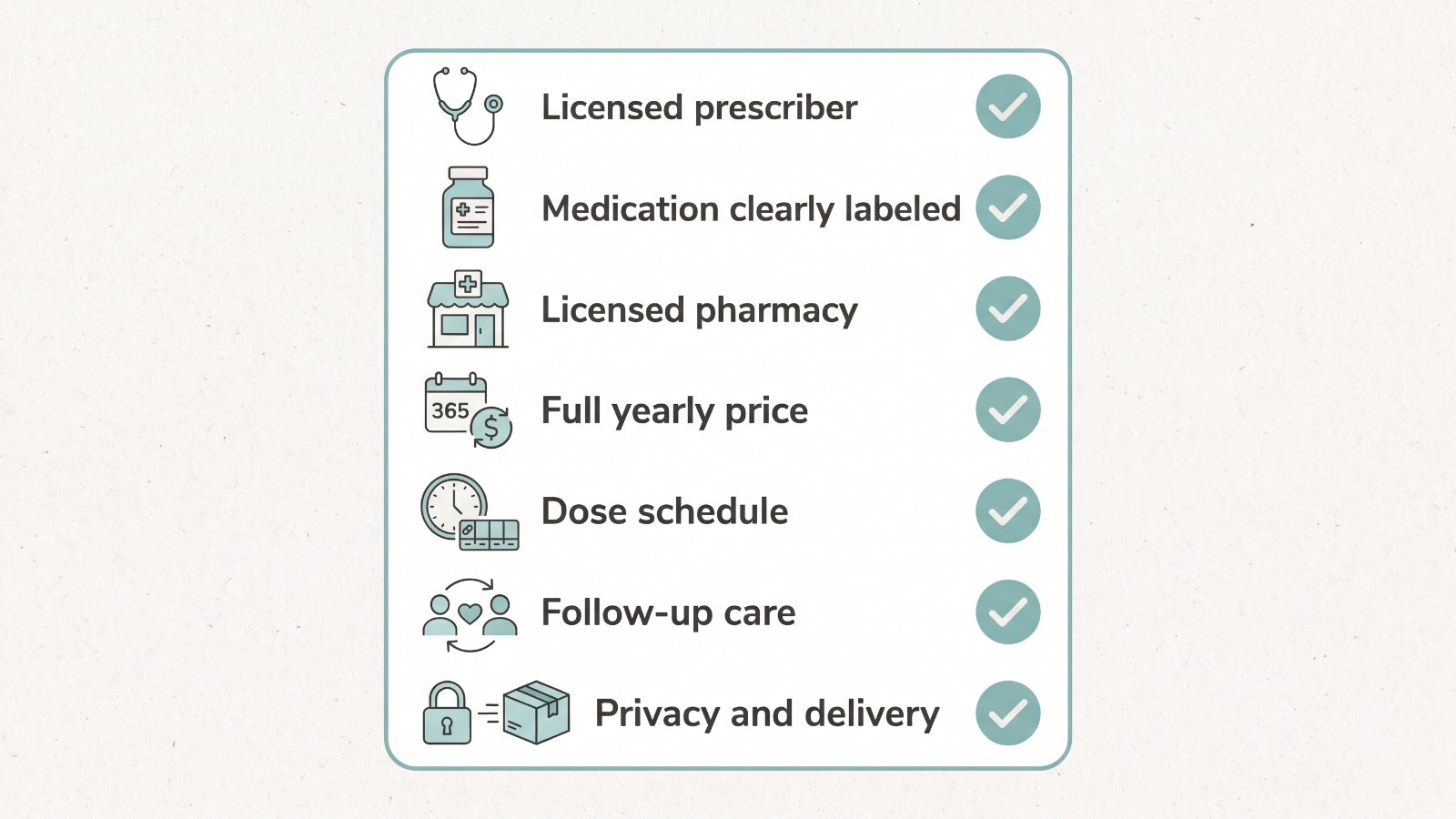
How to choose a GLP-1 provider: 7 things to check
Most online GLP-1 services look the same on the homepage. The differences show up in who reviews your case, what you’re prescribed, what you pay over a year, and what happens when something goes wrong.
1. Which medical provider reviews your health history
A licensed healthcare provider should review your medical history before any weight loss medication is prescribed. On most online platforms that’s a physician or a nurse practitioner, and on the best ones it’s a medical professional with experience in weight management or obesity medicine. Check:
Who the prescribers are. Look for licensed physicians (MDs and DOs) or a nurse practitioner licensed in your state. Telehealth laws vary by state, so the provider reviewing your case should be licensed where you live.
What they ask. The intake form should cover your weight history, current medications, pregnancy or plans for pregnancy, and the medical conditions that make GLP-1 medications unsafe: thyroid cancer history, MEN 2, pancreatitis, and gallbladder disease. It should also ask about other medications you take, since GLP-1s slow stomach emptying and can change how oral medications are absorbed, and about your mental health history, since some GLP-1 labels advise monitoring for changes in mood.
Whether they can say no. A service that prescribes to everyone isn’t screening anyone. A real medical evaluation sometimes ends with “this isn’t right for you.”
You can verify a physician’s or nurse practitioner’s license on your state medical board or nursing board website. Many online platforms name the medical group their providers belong to, which makes that lookup easier.
2. Which medications they offer, and how clearly they describe them
Ask which GLP-1 medications the service offers and whether each one is FDA-approved or compounded. The FDA says compounded drugs are not FDA-approved and are not reviewed for safety, effectiveness, or quality before they’re sold. A provider should say this plainly. Be wary of any service that calls a compounded product a “generic” version of a brand or says it’s the same as an FDA-approved medication. The FDA lists the “same as an FDA-approved drug” claim as a telehealth red flag, and in March 2026 it sent warning letters to 30 telehealth companies over claims implying their compounded products were the same as FDA-approved drugs. The FDA also notes that compounded drugs are not generics, which are FDA-approved.
It also helps if the provider offers more than one option. Semaglutide and tirzepatide work differently, and some patients respond better to one than the other. If the first medication doesn’t suit you, your provider should be able to switch you rather than drop you. Our comparison of semaglutide vs. tirzepatide explains the differences.
3. Where the medication comes from
A legitimate service fills prescriptions through a pharmacy licensed by a state board of pharmacy. Compounded medications should be prepared by a state-licensed compounding pharmacy under sections 503A or 503B of the Federal Food, Drug, and Cosmetic Act. The FDA’s BeSafeRx guide explains how to check an online pharmacy. Independent certification, such as LegitScript, is another sign a service follows the rules. For compounded medications, also ask whether the pharmacy tests its products for potency and sterility, and whether the provider will tell you which pharmacy prepared your prescription. A provider should be able to disclose the source of its compounded medications without being pushed.
Many online GLP-1 providers work with a partner pharmacy rather than letting you pick a preferred pharmacy, so the prescription goes straight from the provider to the pharmacy and then to you. That’s normal for telehealth, but it puts the burden on the provider to work with a licensed one.
The FDA has also flagged fraudulent compounded GLP-1 products with fake pharmacy names on the label, and products sold as “research peptides” that are not prescription medications at all. If a provider can’t tell you the medication comes from a state-licensed pharmacy, that’s your answer.
4. Medication cost, membership fees, and the full price over a year
GLP-1 pricing is quoted in different ways: per month, per plan, or as a membership fee plus medication cost. Some providers charge a monthly membership that covers the consultation and follow-up care, with the medication cost billed separately. Others fold everything into one price. To compare fairly, check:
Whether the price is for medication only, or includes the consultation and follow-up care
Whether it rises as your dose goes up
Whether there’s a monthly membership on top of the medication, and what the membership cost covers
Consultation fees and shipping charges
Whether supplies such as syringes and alcohol swabs are included
Whether you can pay with an FSA or HSA card
How cancellation works and when it takes effect
A low starting price can turn into a high out-of-pocket cost once you reach a maintenance dose, and a membership cost that looked small adds up over a year. Add up the full treatment cost over 12 months at the dose you’re likely to end up on, including any membership cost. That’s the out-of-pocket cost to compare between self-pay providers, not the headline price. Our guide to GLP-1 cost without insurance breaks down what a quoted price usually includes.
5. How dose increases are handled
GLP-1 treatment starts at a low dose that increases over several weeks. The approved labels for both semaglutide and tirzepatide lay out a step-up schedule because starting high causes more nausea and vomiting. Ask who manages your dose increases, how they decide when to move up, and what happens if you need to stay at a lower dose longer.
This matters more with compounded products. The FDA has received reports of adverse events, some needing hospitalization, linked to dosing errors with compounded GLP-1s, including patients measuring the wrong dose from a vial and providers miscalculating doses. It has also received reports of doses taken above the approved labels: more per dose, more often, or increased faster than the labeled schedule. A provider who follows a careful titration plan and explains how to measure your dose is doing part of their job. One who sends a vial and a chart is not.
6. Follow-up care and ongoing support
The first shipment isn’t the end of treatment. Ask how you reach your provider with questions, how side effects are handled, and whether your provider can switch your medication if it isn’t working or you can’t tolerate it. The FDA lists “no licensed doctor available to answer questions after you receive your medication” as a telehealth red flag.
The most common side effects of GLP-1 medications are nausea, diarrhea, constipation, and vomiting, and they’re usually worst during dose increases. Injection site reactions happen but are less common than people expect (1.4% of Wegovy patients in its trials, versus 1% on placebo). Most side effects ease as the body adjusts, often with a slower dose schedule. Less common but serious side effects include pancreatitis and gallbladder problems. Severe stomach pain that doesn’t go away, persistent vomiting, or signs of an allergic reaction mean stop and get medical care, and your provider should tell you that before you start. Our GLP-1 side effects guide covers what’s normal and what isn’t.
Ongoing support also means guidance on the parts of weight loss the medication doesn’t handle. GLP-1 medications are approved for use alongside healthy eating and physical activity, and a personalized treatment plan should say something about both. A provider who never mentions either is treating the prescription as the whole care plan.
7. Privacy and delivery
Your health information should be handled under HIPAA. Injectable GLP-1 medications need to stay refrigerated, so ask whether shipments are temperature-controlled, how long delivery takes, and what happens if a package arrives warm or late. The FDA advises not using any injectable GLP-1 that arrives warm or without enough refrigeration.
Questions to ask before you sign up
Who will review my information, and are they licensed in my state?
Which GLP-1 medications can I be prescribed, and are they FDA-approved or compounded?
Is the pharmacy state-licensed?
What’s the total monthly cost, including fees, and does it change as my dose increases?
How do I reach my provider after my first order?
What happens if I get side effects, or the medication doesn’t work for me?
How do I cancel, and when does it take effect?
If a service can’t answer these clearly, keep looking.
How to compare two GLP-1 providers side by side
The simplest way to work out how to choose a GLP-1 provider is to score two or three online GLP-1 providers against the seven checks on the same sheet. Here’s what that looks like for a hypothetical comparison, with no real companies named:
Check
Provider A
Provider B
Who prescribes
Nurse practitioner licensed in your state
“Our medical team,” no license details
Medications
Compounded semaglutide and tirzepatide, clearly labeled as compounded and not FDA-approved
$143 to $179 a month, no membership cost, shipping included
$99 “starting” price plus $39 monthly membership plus shipping, price rises at higher doses
Dose increases
Provider-managed, with a written titration plan
“Follow the chart in the box”
Follow-up
Ongoing access to your care team through a patient portal; provider can adjust or switch
Email support only
Delivery
Temperature-controlled, 3 to 5 business days
Not stated
Provider B looks cheaper for about six weeks. After that, Provider A’s out-of-pocket cost is lower and it answers every question. Self-pay weight loss works like that: the membership cost and dose increases decide the real price. That’s the pattern to look for. The cheapest GLP-1 provider on the homepage is rarely the cheapest over a year, and it’s almost never the safest.
Insurance coverage vs. cash pay: which kind of provider do you need?
Before you compare providers, decide how you’ll pay. It changes which providers make sense.
If you have insurance coverage for weight loss medication, you’ll usually need a prior authorization showing medical necessity, and your insurance plan will likely cover only FDA-approved branded products for eligible patients who meet its BMI and medical necessity criteria. Some insurance plans cover GLP-1s for type 2 diabetes but not for weight loss alone. Your primary care provider, or an online provider that handles insurance billing and prior authorizations, is the right fit. Expect approval to take days to weeks.
If you’re paying out of pocket, cash-pay telehealth providers are built for you. There’s no prior authorization, pricing is usually flat, and many offer compounded GLP-1 medications at a lower monthly cost than branded products. Self-pay patients also tend to get started faster, because there’s no insurance approval to wait for. Self-pay doesn’t mean skipping the medical evaluation, though. A licensed provider still has to review your health history and decide whether GLP-1 treatment is medically appropriate for you.
Check with your insurance provider before assuming either way. Insurance coverage for weight loss medication changes often, insurance coverage for weight management is narrower than coverage for diabetes, and a plan that didn’t cover it last year might this year, or the reverse. Medicare coverage also depends on the medication and the reason it’s prescribed. If you’re unsure, a call to your insurance plan takes ten minutes and can save you hundreds of dollars a month in out-of-pocket cost.
Compounded vs. FDA-approved GLP-1s: what to know before you choose
Online GLP-1 providers fall into two groups: those that prescribe FDA-approved branded medications, and those that prescribe compounded versions of semaglutide or tirzepatide. Some do both. It matters which one you’re getting.
FDA-approved GLP-1s have been through clinical trials and FDA review. They come as prefilled pens with set doses, and they’re often covered by insurance for type 2 diabetes, less often for weight management. Without insurance, branded GLP-1s commonly cost several hundred to more than a thousand dollars a month at retail.
Compounded GLP-1s are prepared by a pharmacy for an individual patient based on a prescription. They aren’t FDA-approved. They’re usually cash-pay and often cost less than branded products. They’re typically dispensed in multi-dose vials, and the FDA recommends discarding a vial 28 days after first use, even if medication remains, because of contamination risk.
The rules around compounded GLP-1s have changed. According to the FDA, the tirzepatide shortage was resolved in December 2024 and the semaglutide shortage in February 2025. While those drugs were in shortage, pharmacies could compound copies more freely. Now, compounding has to meet the standard 503A and 503B requirements. The FDA’s consumer guidance says compounded drugs should only be used in patients whose medical needs cannot be met by an FDA-approved drug, and the same page raises concerns about some compounded GLP-1 products, including dosing errors, semaglutide salt forms that are different active ingredients from the one in approved drugs, fraudulent labels, and products sold as “research” peptides. As of May 31, 2026, the FDA had received 990 adverse event reports for compounded semaglutide and more than 730 for compounded tirzepatide, and it notes that underreporting is likely.
A provider should be honest about which type you’re getting and why. If the answer is vague, that’s a problem.
Online GLP-1 provider vs. in-person care
Online GLP-1 provider
In-person doctor’s office
Getting started
Online assessment from home
Book an appointment and travel
Who reviews your case
A licensed healthcare provider in your state
Your primary care provider or an obesity medicine specialist
Timing
Often same-day review
Depends on appointment availability
Medication
Shipped to your door
Picked up at a pharmacy
Payment
Usually cash-pay, FSA and HSA eligible
Often billed to insurance
Lab work and physical exam
Not usually included
Available
Best for
Ongoing treatment a provider can evaluate from your health information
New or complex conditions, physical exams, tests
Neither is better for everyone. Online care works well when your weight loss goals are clear, your situation is uncomplicated, and you want a lower self-pay price. In-person providers are the right call when you need a physical exam, lab work, or management of other medical conditions alongside weight loss. Some patients use both: a primary care provider for overall health, and an online GLP-1 provider for the weight loss medication itself. If you do that, tell each healthcare professional about the other, so nobody is prescribing in the dark.
Common mistakes when choosing a weight loss provider
A few patterns come up again and again with patients who switch GLP-1 providers after a bad start:
Choosing on price alone. The cheapest monthly price often excludes the consultation, dose increases, or shipping, and a membership fee may sit on top. By month three the total is higher than the provider that looked more expensive.
Skipping the fine print on compounded medications. If you didn’t know whether you were getting a branded medication or a compounded one until the box arrived, the provider didn’t explain it well enough.
Assuming the first dose is the whole plan. GLP-1 medications are titrated. If nobody has explained how and when your dose will go up, you don’t have a treatment plan yet.
Ignoring state licensing. The provider reviewing your case should be licensed in your state, and medication availability can vary by state because of pharmacy licensing.
Not asking what happens if it doesn’t work. Some patients lose weight on semaglutide and not tirzepatide, or the reverse. A provider with only one GLP-1 option has only one answer.
Stopping the medication altogether without telling anyone. If side effects or cost push you to quit, tell your provider. They may be able to slow the dose schedule, switch your weight loss medication, or plan a taper, and clinical trials show that stopping GLP-1 treatment abruptly usually means regaining weight.
Red flags when choosing a GLP-1 provider
The FDA publishes its own list of telehealth warning signs for compounded GLP-1 medications. These overlap with it and add a few that come from how weight loss treatment is sold online:
The site sells GLP-1 medication without a prescription or a medical evaluation.
The site calls its compounded product “generic” or says it’s the same as a branded drug.
The site doesn’t say a licensed provider reviews your information, or that a state-licensed pharmacy fills your prescription.
The price is far below everyone else’s, or there’s no clear total.
The site promises a specific amount of weight loss. Results vary, and no honest provider guarantees them.
The product is sold as a “research peptide” or “not for human consumption.” The FDA has warned companies selling these directly to consumers.
Nobody is available to answer questions after your medication arrives.
Independent patient reviews and complaints describe shipping problems, billing surprises, or no response from the care team.
Published rankings of online GLP-1 programs (the lists that compare Ro, Hims & Hers, Mochi Health, Remedy Meds, Noom Med, Weight Watchers’ medical program, and others) are a useful starting point for names, but they rarely score the seven checks above with equal weight, and many carry affiliate links. Run every provider, including the ones on those lists and including Provn, through the same checklist yourself.
When an online GLP-1 provider isn’t the right choice
Online care works well for many patients, but not everyone. See a doctor in person if you have type 2 diabetes that’s already being managed with medication, if you’re pregnant or planning a pregnancy, if you have a history of pancreatitis or thyroid cancer, or if you want a branded medication covered by insurance. An in-person visit is also the right call when you need a physical exam or lab work, or when other medical conditions such as kidney or liver disease need monitoring. The Mayo Clinic covers when prescription weight loss medication makes sense and when it doesn’t.
How online GLP-1 treatment works with Provn
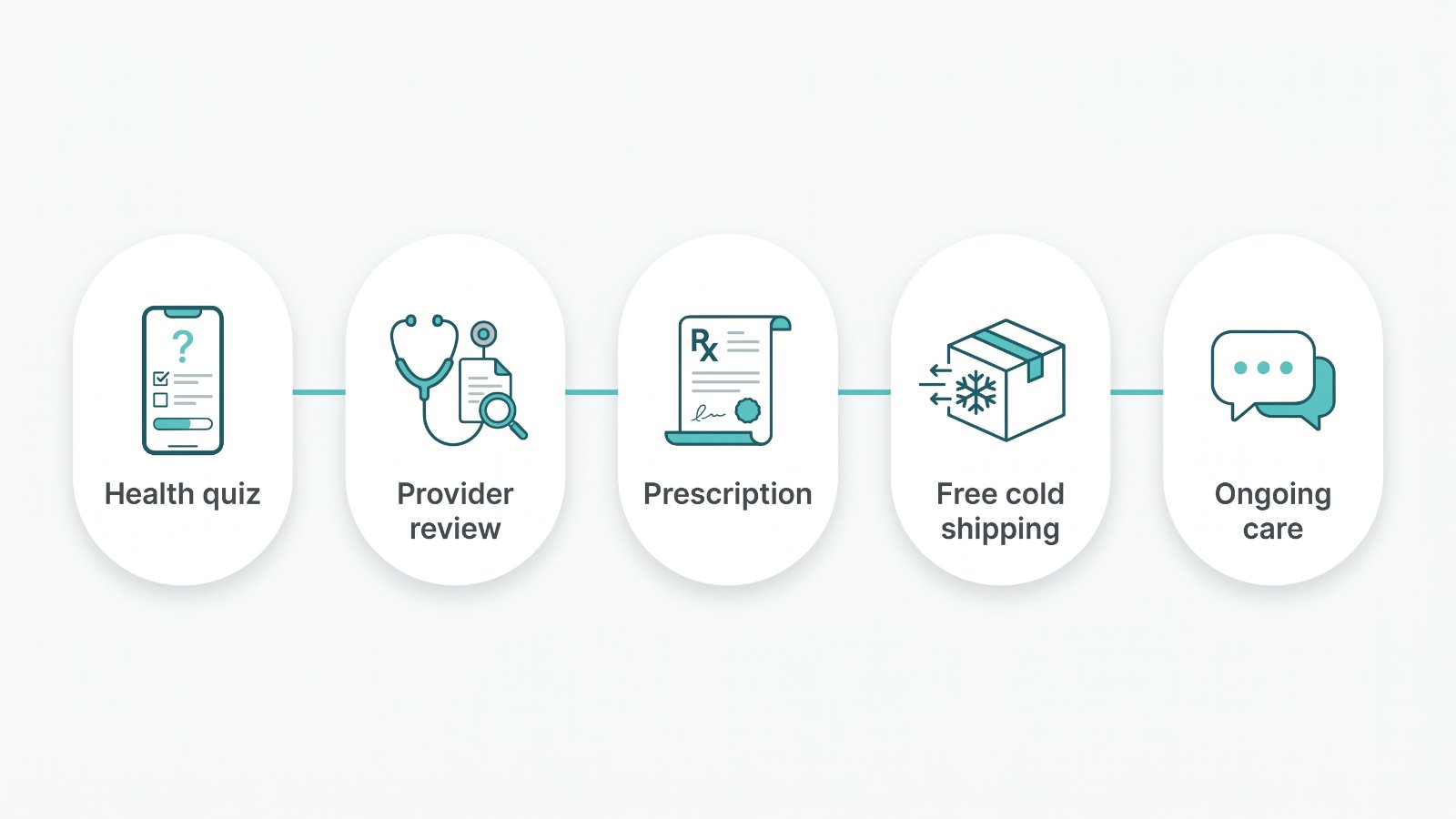
Provn connects you with licensed U.S. providers who can prescribe two compounded GLP-1 weight loss treatments: compounded semaglutide and compounded tirzepatide. Prescriptions come from licensed physicians (MDs and DOs) and nurse practitioners from physician-led medical groups. Here’s how the process works, measured against the seven checks above.
Take the health quiz. Answer questions about your health, medications, and goals online.
A licensed provider reviews it. A U.S.-licensed provider in your state reviews your quiz in a same-day consultation. The prescribing decision is always your provider’s.
Get your prescription, if it’s right for you. Your provider sets your dose and any changes to it. A state-licensed compounding pharmacy prepares the medication; Provn isn’t a pharmacy.
It ships free. Expedited shipping is free on every plan. Most patients receive their medication within 3 to 5 business days of being prescribed, in plain, temperature-controlled packaging.
Ongoing care. You keep access to your care team after your treatment arrives, and you can contact them about questions, side effects, or health changes. Any change to your dose or treatment is your provider’s decision. Medication works alongside healthy eating and physical activity, not instead of them.
You don’t need insurance, the consultation is included in the plan price with no separate membership fee, shipping is free, and qualifying treatments are FSA and HSA eligible. Both are compounded by state-licensed pharmacies and aren’t FDA-approved. Compounded semaglutide isn’t Wegovy® or Ozempic®, and compounded tirzepatide isn’t Zepbound® or Mounjaro®. You can cancel from your account dashboard or by contacting support; cancellation takes effect at the end of your current billing cycle, and any unused medication is yours to keep.
If a GLP-1 isn’t right for you, your provider may discuss other options. Provn also offers low dose naltrexone, a non-GLP-1 daily capsule prescribed off-label. LDN isn’t FDA-approved for weight loss.
Provn is LegitScript certified and serves patients in 46 states. Availability can vary by state.
Weight loss with GLP-1s depends on the provider as much as the medication. If you remember nothing else about how to choose a GLP-1 provider, remember this order: medical review first, medication and pharmacy second, full price third. A good online GLP-1 provider has a licensed healthcare provider or nurse practitioner review your health history, tells you plainly whether your weight loss medication is FDA-approved or compounded, fills it through a state-licensed pharmacy, shows the full yearly cost, manages your dose increases, and stays reachable after the box arrives. Everything else, including price, is a tiebreaker. A healthcare provider who does all of that, online or in person, gives you the best chance of long-term weight loss.
Frequently asked questions
Can I get a GLP-1 prescription online?
Yes. A licensed provider can review your health information online and prescribe a GLP-1 medication if it’s appropriate for you. You can’t get one without a medical evaluation.
Are online GLP-1 providers legitimate?
Many are. Look for a licensed provider review, a state-licensed pharmacy, clear pricing, and HIPAA-protected records. Avoid any site that sells GLP-1 medication without a prescription or calls a compounded product “generic.”
Is compounded semaglutide the same as Wegovy?
No. Compounded semaglutide is prepared by a compounding pharmacy for an individual patient. It isn’t FDA-approved, and the FDA doesn’t review it for safety, effectiveness, or quality.
Is compounded tirzepatide still legal?
Compounding is still permitted under federal law when a licensed provider prescribes a compounded medication for an individual patient and the pharmacy meets 503A or 503B requirements. Since the FDA declared the tirzepatide and semaglutide shortages resolved, pharmacies can no longer compound copies based on shortage status alone.
Do I need insurance for online GLP-1 treatment?
Not with cash-pay providers. Insurance coverage mainly matters if you want a branded medication. With Provn, plans start at $143/month for compounded semaglutide on a 12-month plan, and qualifying treatments are FSA and HSA eligible.
How fast can I start?
With Provn, a provider reviews your health quiz in a same-day consultation. If you’re prescribed, most patients receive their medication within 3 to 5 business days.
How long do I need to take a GLP-1?
Treatment length depends on your goals and how your body responds. Clinical trials show that stopping GLP-1 medication usually leads to weight regain, so many providers treat it as long-term therapy. Your provider decides with you whether to continue, reduce the dose, or stop.
Are there oral GLP-1 options?
Yes. The FDA has approved oral GLP-1 medications for weight management, including semaglutide tablets (Wegovy® tablets) and orforglipron (Foundayo®), which was approved in April 2026. In Foundayo’s 72-week trial, adults on the highest dose lost an average of 12.4% of their body weight, compared with 0.9% on placebo, according to Lilly’s announcement. Weekly injections remain the most common form of GLP-1 weight loss treatment. Provn’s GLP-1 options are injectable compounded semaglutide and compounded tirzepatide; it does not sell oral GLP-1 products.
What if I can’t do injections?
Provn offers low dose naltrexone, a daily capsule and a non-GLP-1 option prescribed off-label. Your provider decides whether it fits your situation. Read how to get low dose naltrexone online.
Can a nurse practitioner prescribe GLP-1 medications online?
Yes, in most states. Nurse practitioners are licensed healthcare providers who can prescribe weight loss medication within their state’s scope of practice. With Provn, prescriptions come from physicians and nurse practitioners licensed in your state.
Does a GLP-1 provider need to be a weight loss specialist?
No, but experience with weight management helps. What matters most is that a licensed medical provider reviews your health history, follows the labeled dose schedule, and stays available for follow-up care.
How hard is it to get a GLP-1 prescription online?
Not hard if you qualify, and you shouldn’t want it to be easy if you don’t. Most online platforms ask for an intake form, a current weight and height, and your medical history, then a licensed healthcare provider reviews it. Eligible patients, usually adults with a BMI of 30 or higher, or 27 or higher with a weight-related condition and no contraindications, can often have their intake reviewed the same day. If a provider turns you down, ask why. It’s usually a safety reason, and it’s useful to know.
Where can I get a GLP-1 without a membership fee?
Some online GLP-1 providers charge a monthly membership on top of the medication cost, and some don’t. Provn doesn’t: the plan price includes the consultation, the prescribed medication if approved, ongoing provider access, and shipping, with no separate membership fee. When comparing, ask each provider to confirm in writing what the monthly price includes.
Who is the most trusted GLP-1 provider?
There’s no single answer, and any site that names itself is selling something. The most trusted GLP-1 provider for you is the one that passes the seven checks in this guide: licensed prescribers in your state, clear labeling of what you’re getting, a state-licensed pharmacy, honest full pricing, a managed dose schedule, real follow-up care, and HIPAA-compliant handling of your information.
What is the cheapest GLP-1 medication without insurance?
For self-pay patients, compounded semaglutide is usually the lowest-cost GLP-1 weight loss treatment, followed by compounded tirzepatide, with branded products costing the most at retail. Manufacturer cash-pay programs for branded medications exist and change often, so check current pricing before deciding. Cheapest isn’t the same as best: the medication cost is one line of a bigger treatment cost.
Can I use an online GLP-1 provider if I have type 2 diabetes?
It depends. GLP-1 medications help control blood sugar, and some are approved for type 2 diabetes. But if your diabetes is already managed with medication, adding a GLP-1 can affect blood sugar and may need dose changes to your other medications. That’s usually better handled by the provider who manages your diabetes. Tell any online provider about your diabetes diagnosis and current medications.
Will anyone know what I ordered?
Provn ships medication in plain packaging, and your consultation and records are handled in compliance with HIPAA.